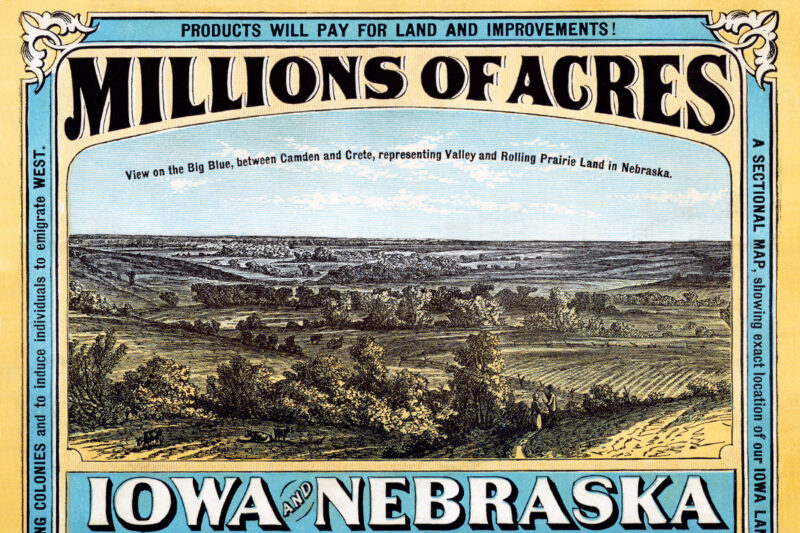
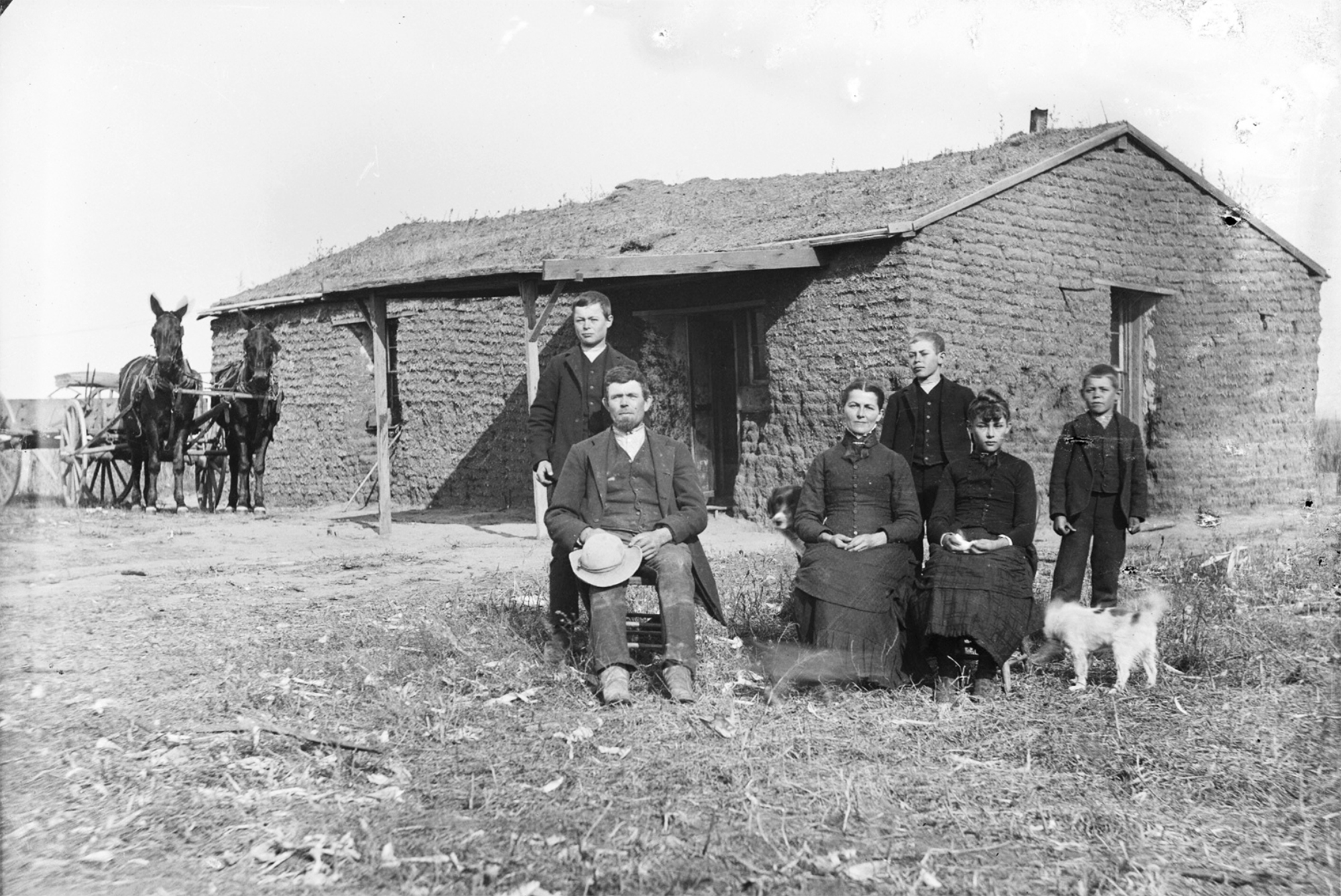
The Homestead Trap of 1862 2-29-25
There is so much more I coud say about the torture & suffering of these pioneers but I shall do so in the future. The thing is – the U.S. Govt could have provided help, but they gave NOTHING – What do you expect from uncaring Patriarchs? Look what they did to the Indians.
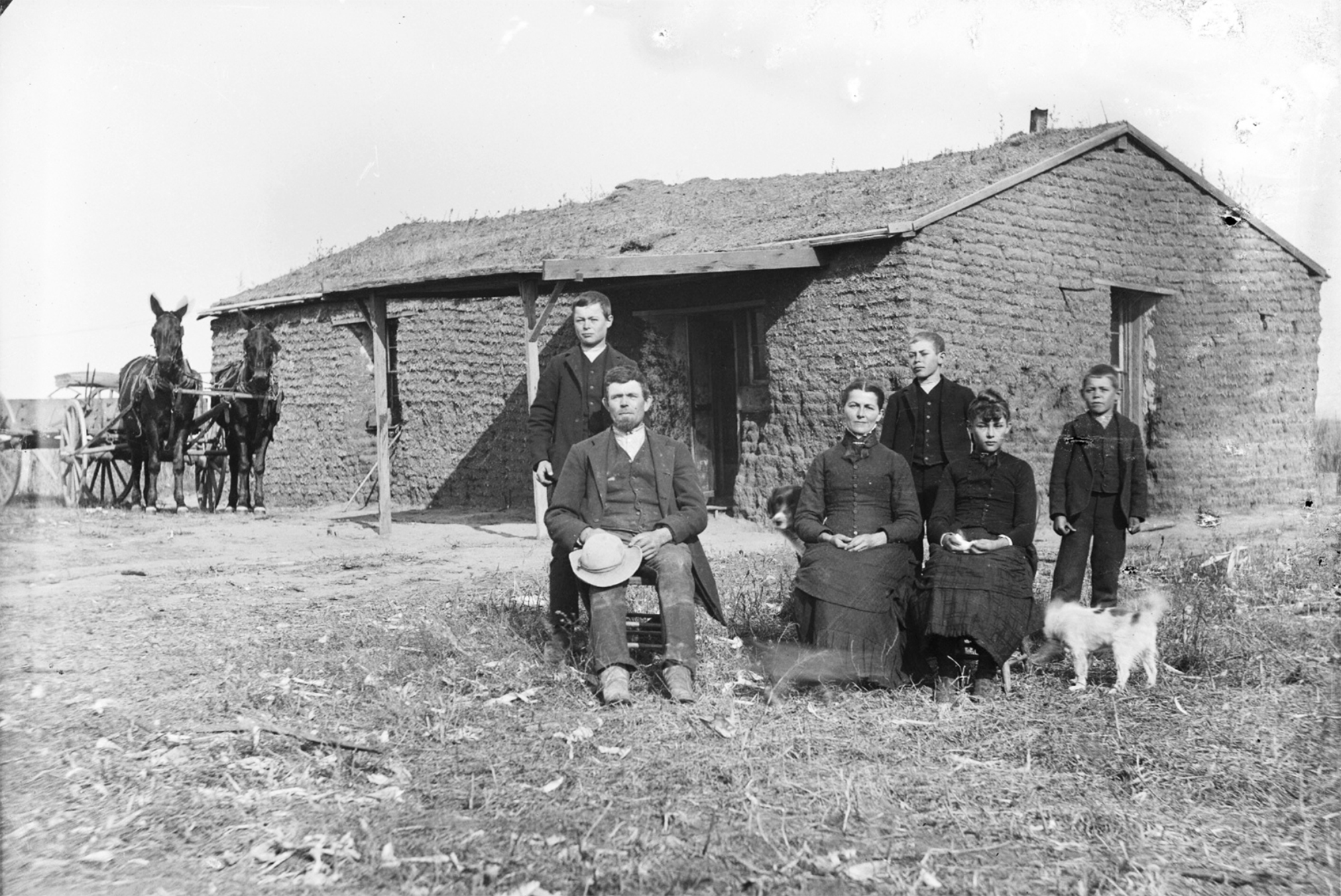
You get 160 acres but you must build your own house {before winter} & live there for 5 years, work the land, in order to get the deed. Some of these areas had NO TREES TO BUILD WITH, no easily obtainable water, the ground was sod, incredibly hard to till for planning of crops. No one wanted to move there so they used THE POOR with this fallacious promise of FREE LAND to settle there. These were the pioneers. No rich person, no middle class person, no person who had anything – would want to go there & face the terms – you had to be DESPERATE. They used the poorest of the poor regardless of the dangers.
The American govt is responsible for the suffering & the terrible loss of lives by sending these people into amost impossible situations. No couple with children should have gone out there alone. There should have been villages built first to accomodate people in emergencies. The public – all poor people – did not understand what they were getting into – it was a death trap. What percentage of these innocent people froze to death in winter or died because of the suffering, stress & illness? The govt knew or should have known what the conditions were in winter. The govt should have provided, say, a few buildings in the center of an area, with all the provisions needed – medical supplies – food emergency supplies – & a real large cabin where the folks could escape to when it got to be blizzards, 40 below with hurricane winds & cabins collapsing, roofs caving in, fireplaces that were inadequate & they culd get no more wood. One area triple heated building should have provided safety for all those who could not survive the bizzards. The govt knew this & used poor people as guinea pigs to settle the states with Arctic conditions. They figured, so some of them die, but not all will die, & the ones that survive, we’ll get these states occupied. They did not care re the welfare of these poor people. They sacrificed the poor, the innocent, & sent them into death traps. {from Rasa Von Werder}
Official from the Internet:
Of the two million that made claims of 160 acre parcels of land throughout the life of the Homestead Act, approximately 783,000 were successful, “proving up” on their pieces of ground after the required five years and acquiring their individual deeds. This number demonstrates that about 60 percent of those that began the homesteading process never completed it. Why was the failure rate so high? Many factors contributed to claimants not lasting five years.
{This was only repealed in 1986! Another article states: Although the act was officially repealed by Congress in 1976, one last title for 80 acres in Alaska was given to Kenneth Deardorf in 1979. }
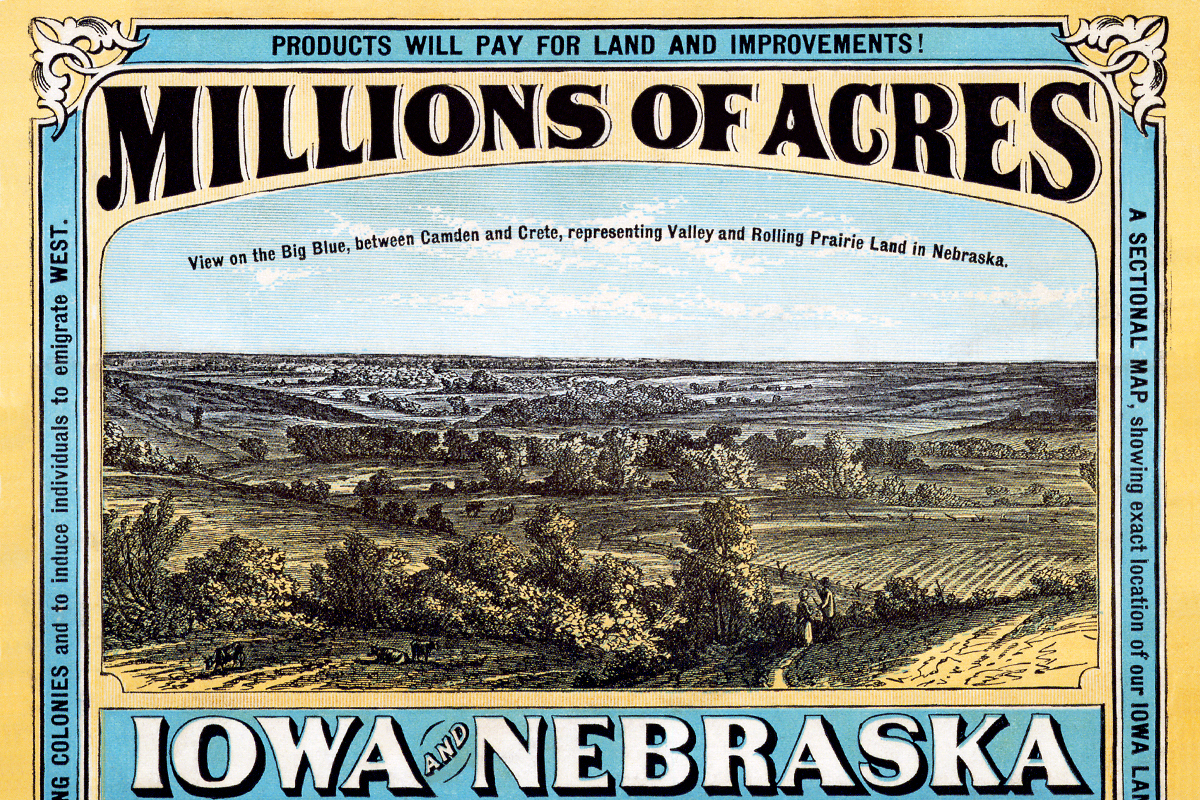
Foremost among these factors was the sheer difficulty of farming on so many of the midwestern and western lands. The ground was often tough, or the soil of an extremely poor quality. One Kansas town advertised itself as having soil of a “rich, black, sandy loam.” When settlers arrived, however, they found that “sandy” was the only part of the description that held any truth. Many farmers simply could not make anything grow in the ground they had chosen.
Natural disasters were also forces that created problems for farmers. Prairie fires, winter blizzards, tornadoes and insect infestations were all capable of destroying a year’s worth of work in just a few hours. Some homesteaders succumbed to the seclusion and isolation of farming in remote territories where another human being was often not seen for months. Poor hygiene and lack of proper medical care often led to illnesses that wiped out entire homesteader families. The common cold could easily develop into pneumonia when the closest doctor was a hundred miles away.
Though homesteaders often had numerous things working against them, many also possessed a strong determination to succeed and truly own the pieces of ground they were temporarily “borrowing” from the government. Many had escaped hard lives and terrible conditions in cities and preferred the harsh but rewarding life of a farmer to that of a poor city dweller. Many also knew that the Homestead Act offered them their only real opportunity to ever be landowners and to achieve the American dream of land and home ownership. How else could a poor person get 160 acres and a farm of his or her own? Once acquired, they often swore they would hold the land the rest of their lives. Through the actions and attitudes of so many, the Homestead Act was responsible for the settlement of nearly ten percent of all the land in the 48 continental United States and Alaska.”
How many died from trying to fulfill the Homestead Act? From Google:
While exact death tolls are unknown, thousands died from the extreme hardships (blizzards, insects, poverty, isolation) faced by homesteaders under the Homestead Act of 1862, with conditions like sod houses, limited fuel/water, and crop failures causing immense suffering, though specific fatality numbers are lost to history, overshadowed by the vast numbers (millions) who successfully claimed land.
Why Exact Numbers Are Missing
- Vast Scale: Millions of claims were filed, making precise tracking of individual deaths difficult, notes the National Archives.
- Frontier Conditions: Deaths from natural causes, disease, accidents, or starvation weren’t always officially recorded as “Homestead Act deaths” but as general frontier fatalities.
Conditions Leading to Death
- Harsh Weather: Extreme cold, wind, and blizzards were common, especially in the Plains.
- Sod Houses: Lack of timber forced homesteaders to build homes from sod, which offered poor insulation and harbored insects.
- Resource Scarcity: Finding enough water and fuel for cooking and heating was a constant, life-threatening struggle.
- Crop Failure: Droughts and plagues of insects (like grasshoppers) destroyed harvests, leading to starvation.
- Isolation & Poverty: Families were cut off from supplies, and poverty made basic survival precarious.
In essence, the Homestead Act was a brutal test of survival; many perished, but the sheer number of successful homesteaders (over 1.6 million official patents) means a precise death count remains elusive, lost in the harsh reality of settling the West.
It Begins {from the Internet}
The “Homestead Act of 1862” went into effect at midnight on Jan. 1, 1863, along with the Emancipation Proclamation that freed slaves in states that were in rebellion. That day, Daniel Freeman of Iowa persuaded James Bedford to open up the Brownville, Nebraska, Land Office in the middle of the night so that he could file a claim right away.
The office wasn’t slated to officially open up until Jan. 2, but Freeman, who was a Union soldier on a brief furlough, had been ordered back to St. Louis and wouldn’t be in town to file his claim the following day. Bedford agreed to accommodate Freeman’s unique situation. And so, at 12:10 a.m. 159 years ago, Freeman became the first person to take advantage of the Homestead Act.
He was joined by 417 other men in filing claims that first day in a foreshadowing of how popular the act would become. All told, a whopping 270 million acres were claimed by homesteaders between 1863 and 1976 when the act was repealed, save for Alaska, where it was extended until 1986. That comes out to a full 10% of the entire United States. It provided, in Lincoln’s words, a “fair chance” for people to make their own way in The Land of Opportunity.
Expansion into the Western portions of North America had been a primary goal dating all the way back to the colonial era when places like Ohio and Kentucky were on the western edge of civilization and people were clamoring to branch out into new, unsettled areas.
As time passed and the concept of Manifest Destiny took hold, the United States’ landholdings stretched all the way to the Pacific Ocean, but the formalization of those lands as part of this new country lagged behind.
Worry about the spread of slavery into these Western lands led to previous versions of the Homestead Act failing three times in the House, and it was killed once by a veto from President James Buchanan in 1860.
A Hard Life and a Lot of Work
While 160 acres may sound like a lot of land — and it was to Easterners at the time — the landscape was far different out West, and many homesteaders would soon discover what worked in one part of the country wouldn’t cut it in another.
Decades before the Dust Bowl ravaged much of middle America, countless homesteaders in those same places discovered it was fairly easy to lay claim to the land, but it would take a tremendous amount of work to tame it.
It was a tough life, and Mother Nature didn’t do anything to make it easier. Locusts, blizzards, prairie fires, tornados, drought, and wind were just some of the many natural hardships the homesteaders would endure.
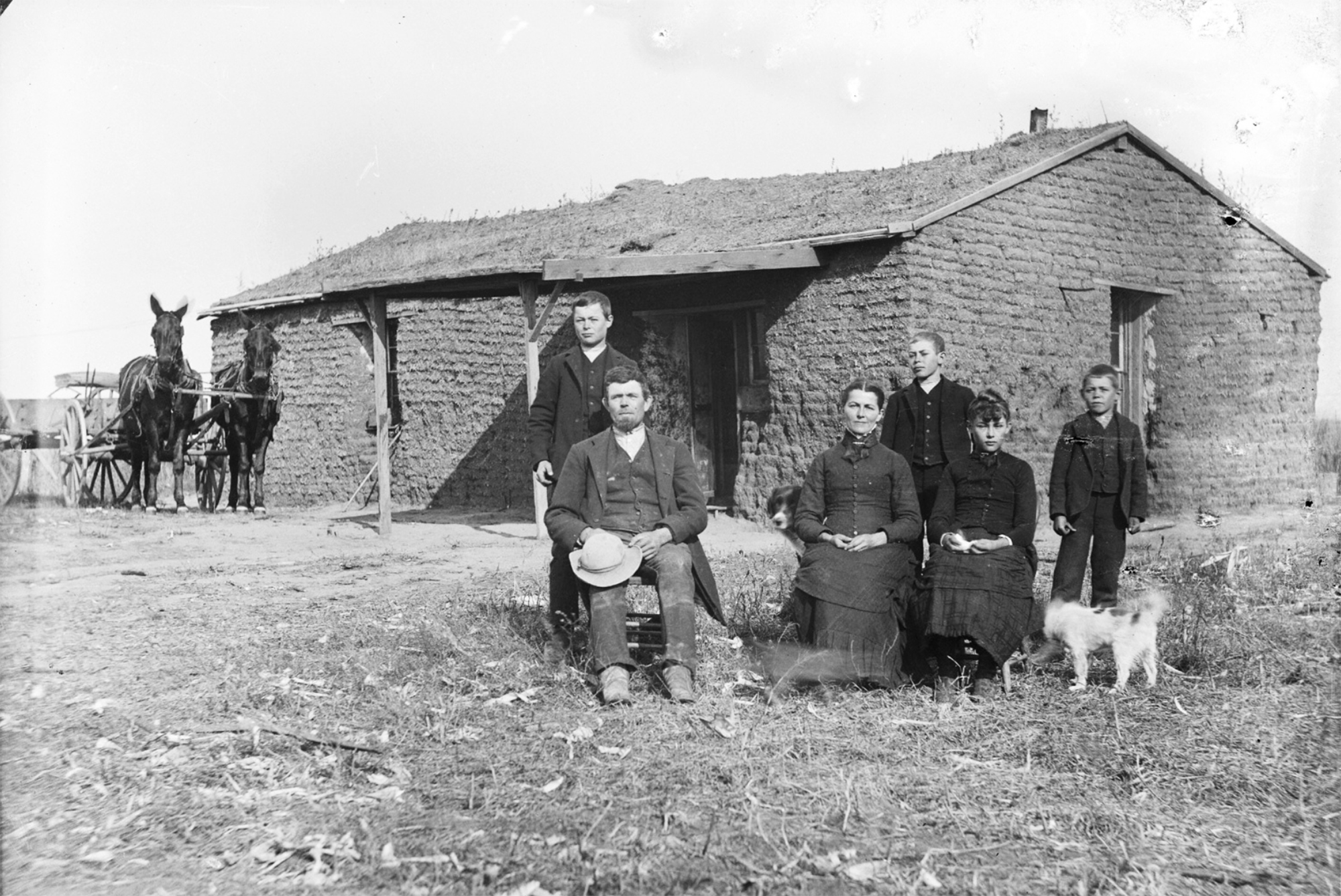
On top of all that, sparse trees and limited lumber forced many to live in sod houses that were far more primitive than any subpar dwellings they would have encountered back East — even for the time, it was primitive living. Because of these reasons and others, it’s believed that some 60% of all homestead claims were eventually abandoned.
While the act had a provision that reduced the residency requirement from five years to six months, it also required payment of $1.25 per acre to take advantage of the reduction. That comes out to $200 for 160 acres or about $4,400 when adjusted for inflation. In today’s dollars, that’s a hell of a good deal, but in 1863 money, the average laborer made around $300 per year.
Homesteaders Came From all Walks of Life {All types of poor people they mean – Rasa says}
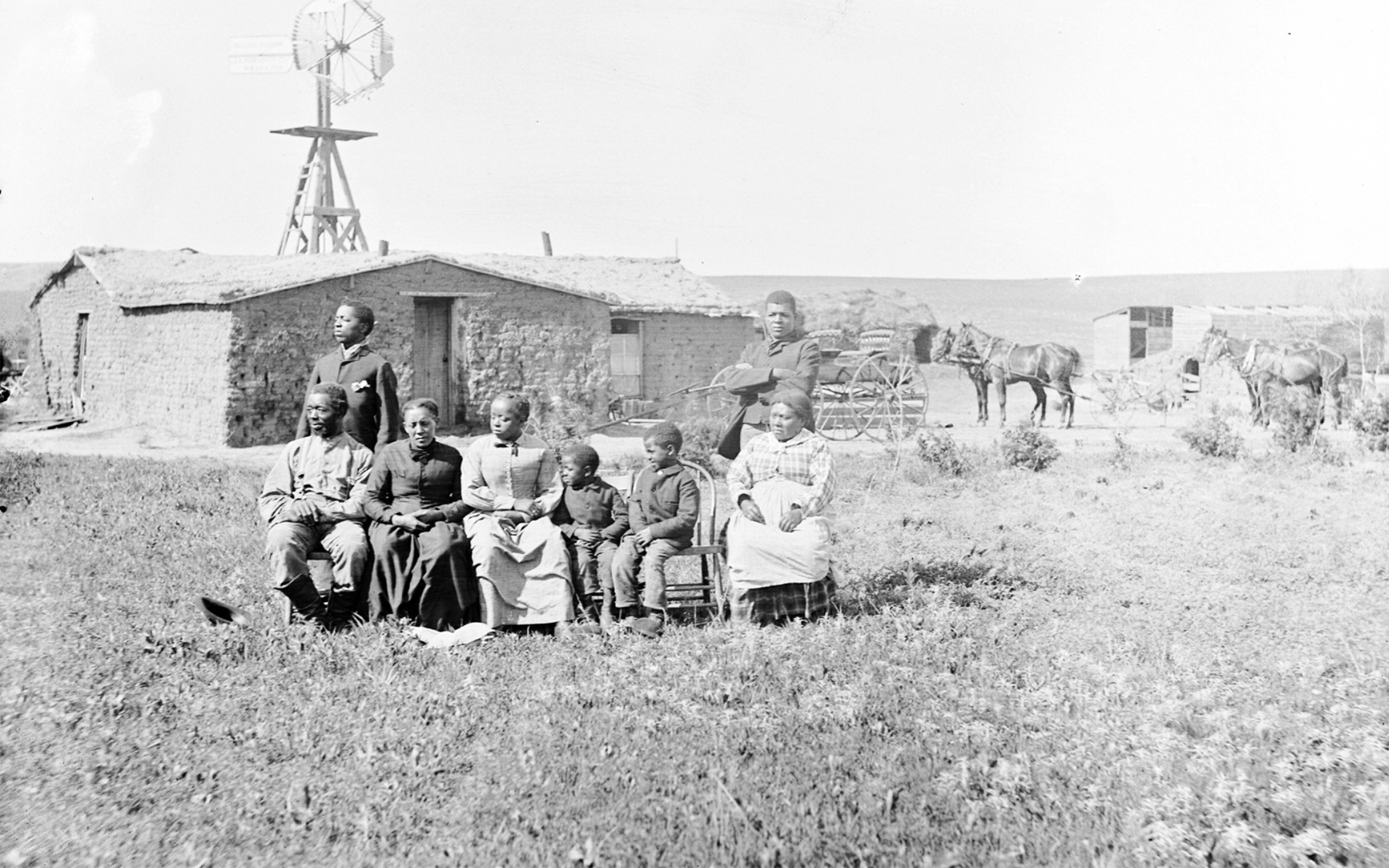
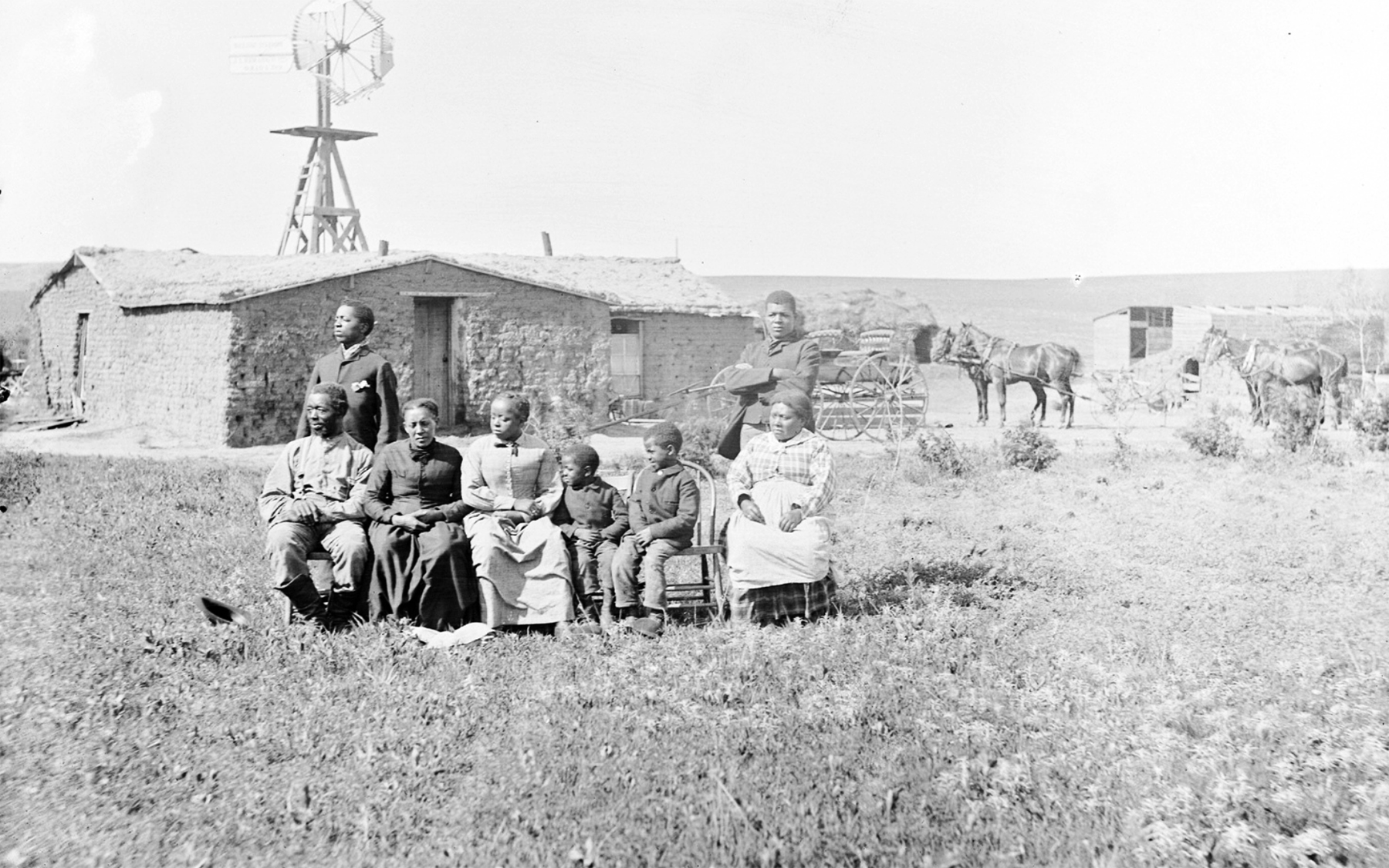
While we tend to think of homesteaders as just a bunch of white guys grabbing up land, the reality was far different. Homesteaders were men, women, formerly enslaved people, and immigrants of all kinds. Women who were single, widowed, divorced, or abandoned could set up claims in their own name, and thousands of them did. Millions of others helped their families in improving the land so that they could fulfill the requirements of the homesteading agreement.
Such was the case for Jeannette Rankin of Montana, who helped improve the 160 acres claimed by her family under the act. She went on to become the first woman elected to the US House of Representatives in 1916, a full four years before women were granted the right to vote under the 19th Amendment.
Moses Speese was born into slavery on a North Carolina plantation in 1838. After the Civil War, he and his wife Susan became sharecroppers, but like many newly-freed enslaved people, they were cheated by the landowners. Despite having members of their family held hostage when they tried to leave, the family eventually made it to Indiana.
Proving only slightly more accomodating than North Carolina, Nebraska became the Speese family’s home in 1880; they filed a homestead claim in 1882 for 158 acres. Taking advantage of the Timber Culture Act of 1873, Moses filed a second claim for 160 acres. When all was said and done, he and his family fulfilled their obligations and paid $3.96 to file paperwork for 316 acres of land.
Many of the immigrants who made their way to the United States during the Civil War and the Indian Wars of the 1870s went immediately into the military. All veterans, native-born or immigrants, were allowed to file claims even if they didn’t meet the age requirement as a special benefit.
Time spent in the service was also allowed to be applied to the residency requirement, reducing the five-year term to as little as one year.
The Consequences of Expansion {Rasa says: Indians Robbed – Again!}
While claimants of all kinds enjoyed the opportunity provided by Lincoln’s fair chance, it had unfair consequences to the Native Americans who had inhabited for generations the lands that were now being given away to strange newcomers.
Already adversely impacted by the Indian Appropriations Act of 1851, the Homestead Act of 1862 added insult to injury for the Native Americans who had once called what was now the Eastern US home and had barely begun to establish roots in their new Western lands before being uprooted once again.
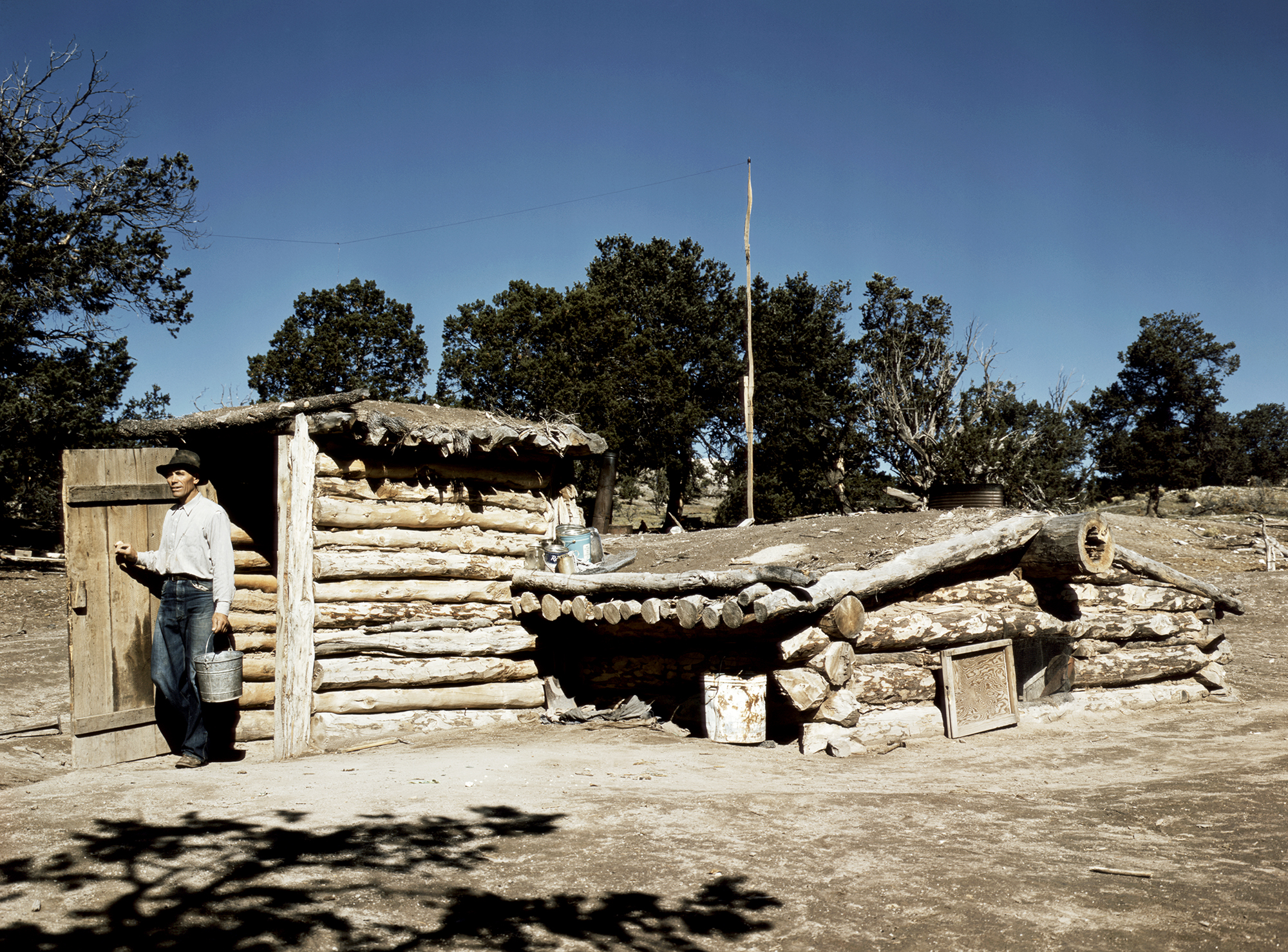
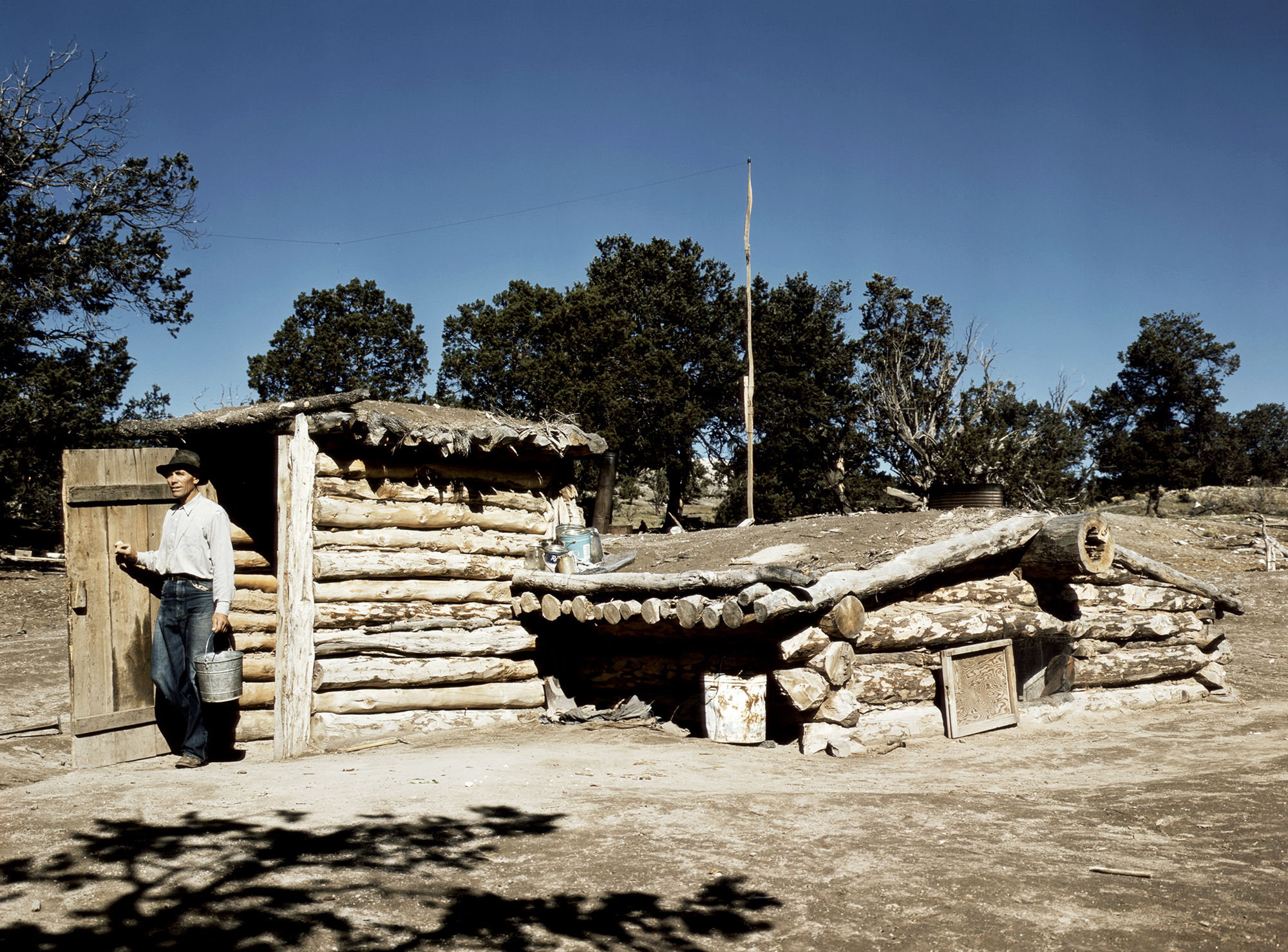
Dugout home from a homestead near Pie Town, New Mexico, 1940. Wikipedia
Native populations with established roots in these Western lands watched homesteaders irrevocably change the landscape forever. Water sources were diverted, fences were erected, non-native plant species were introduced, and the native wildlife (chiefly the bison) were hunted beyond sustainability.
More land claims and Western migration caused even greater pressure on the Native way of life as the 19th century pressed on and gave way to the 20th. Soon, lands set aside for reservations were divided up even more, and the tribes were left with less and less land each time.
Without a doubt, the treatment of Native Americans is one of the most significant and saddest legacies of the Homestead Act — if not all of American history. But despite the wrongdoings, it remains the history of this nation, and we have to acknowledge it as such, as well as the good that came from the Homestead Act for more than a century.
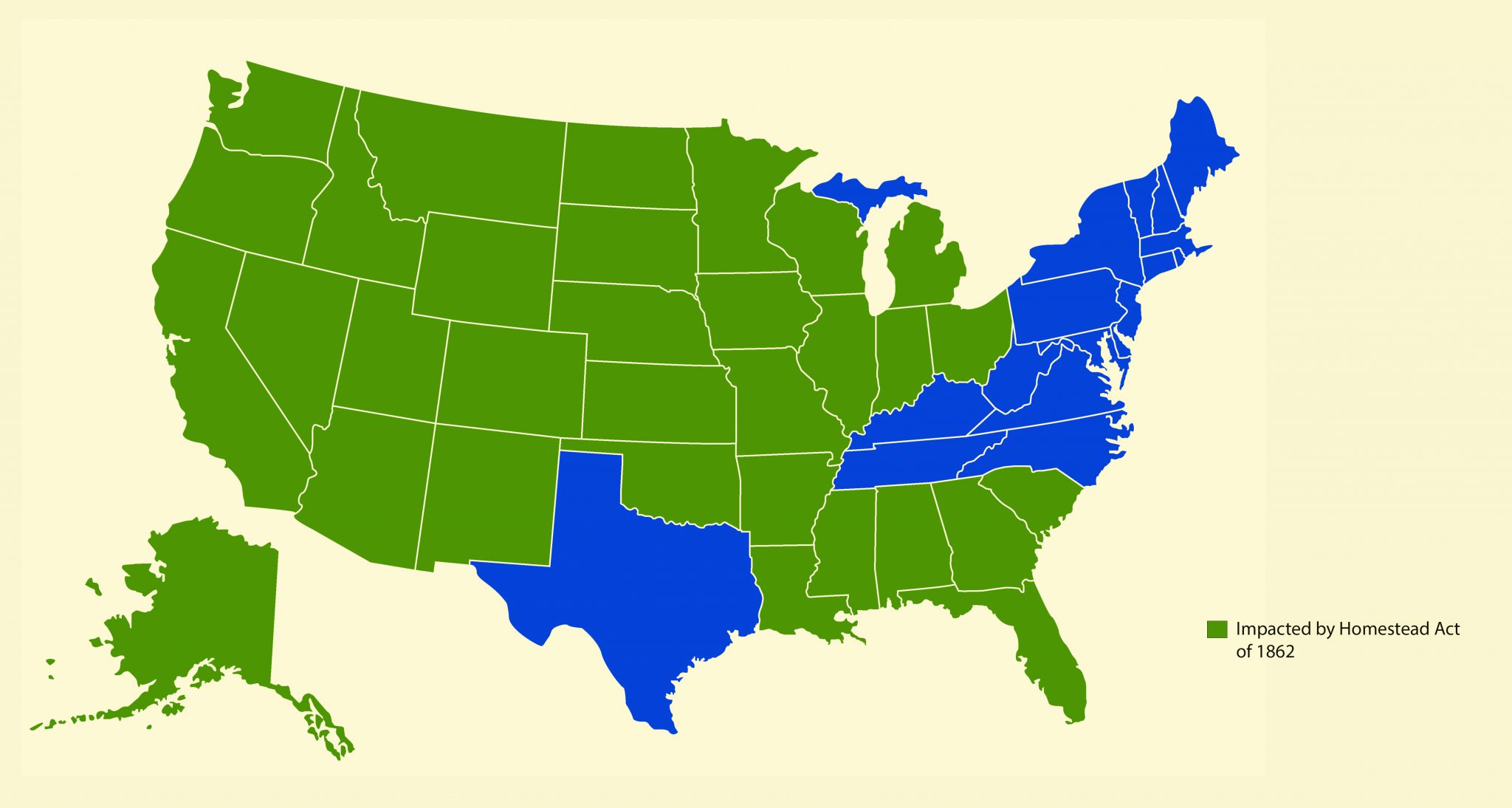
A map of the current United States showing the areas impacted by the Homestead Act of 1862. Free Range American
Daniel Freeman, Jeannette Rankin, and Moses Speese are representative of the million-plus Americans who used the Homestead Act to establish a new American way of life and can-do survival attitude that endures to this day in the Western parts of this country.
Without the Homestead Act, countless lower- and middle-class Americans would never have been able to realize the dream of owning a piece of land to call their own. By the time the act was repealed in the lower 48 in 1976, more than 4 million people had made successful claims in 30 states.
It is rumored that Mark Twain once said, “Buy land, they’re not making it any more.” Whether Americans bought it or claimed it, the sentiment remains the same, as land continues to be one of the cornerstones of the American identity, and no one has, as of yet, created any more.
To be continued – Part II – by Rasa Von Werder
I will describe the horrendous conditions many perished under as told trough historic narratives – & how certain men who had knowledge from Europe: – Russia – Norway – Germany – Ireland – etc – built dwelling in caves, underground, double-roof or double-wall homes – deep covered trenches for cattle – Understood thermal mass to keep a home warm – the ancient systems tried for millennia that their grandfathers told them about.
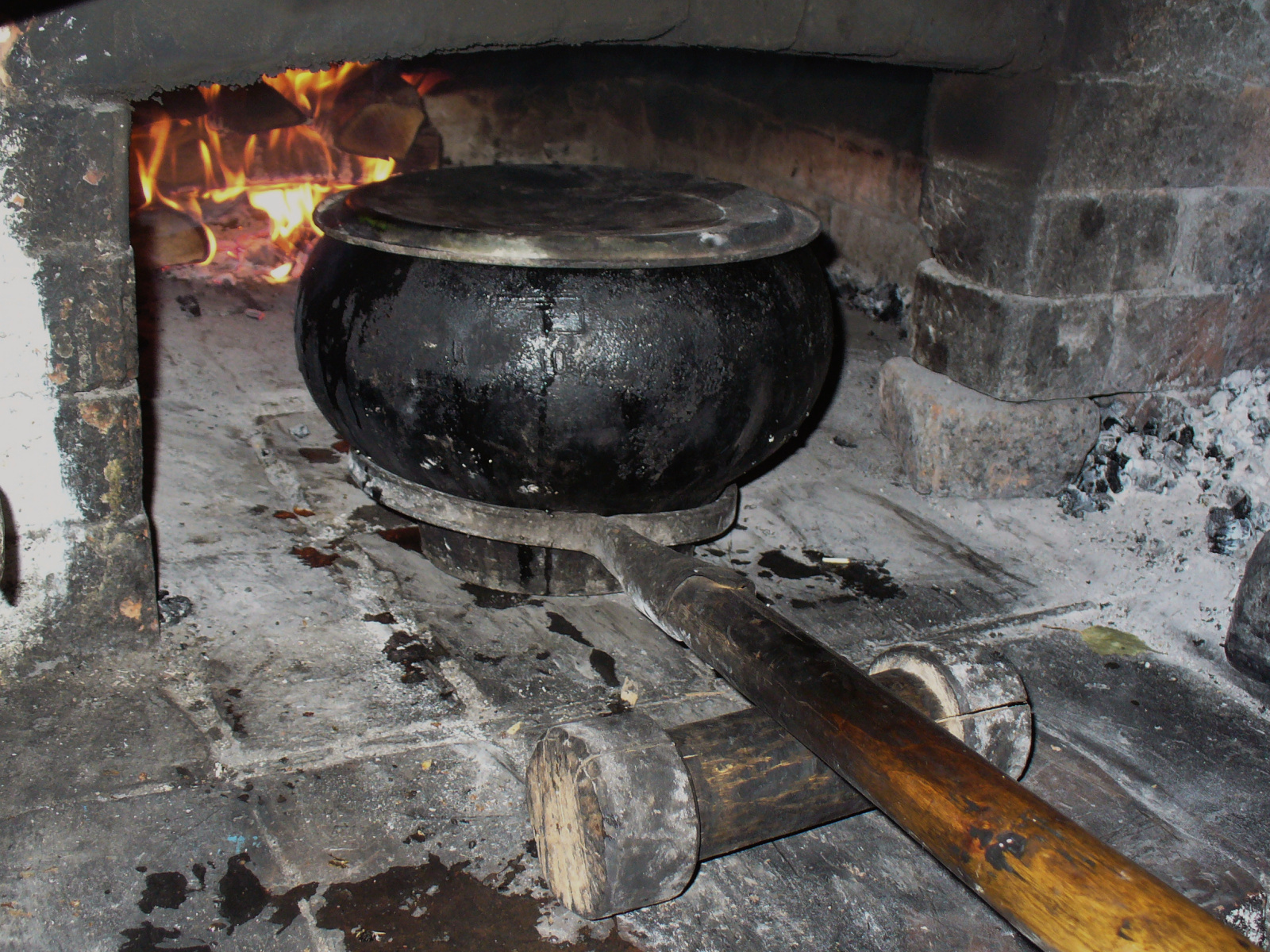
The average pioneer {from the East mostly}, knew they had a few months to build their cabin – time was of the essence as they had a gazillion other things to do like hunt to supply meat for all winter, smoke it, salt it, chop firewood to last four months – {six cords at least} – grow certain types food they could preserve in their root cellar & feed for the animals while at the same time – all within six months – build a log cabin!
Those who had wood {the majority were sod houses! – just pure large dirt bricks weighing 50 lbs!} the cabins were made slam, bam, thank you ma’am. Straight beams of wood, roofs that did not have extreme pitch {less than 40% – had they made them 40% or steeper it could have saved them from roofs caving in from snow.} The prevailing wisdom was fill the gaps between logs with dirt, grass & moss – which served OK during average winters but they were not told that once in a while a winter would hit that was like the Arctic, – cattle would freeze to death just where they stood outside – most of the calves in barns would freeze to death, where men would perish from whiteouts while getting wood just 30’ from their barn or house!
Not only that they could get no more supplies from the railroad because the snow crippled train tracks! Even if they could get out the snow was waist high with drifts up to 15’ – at times covering houses up to the roof! How could they even have a road to get to the general store miles away? That means some people – unless thy could get to a neighbors – would STARVE to DEATH! And that included children!
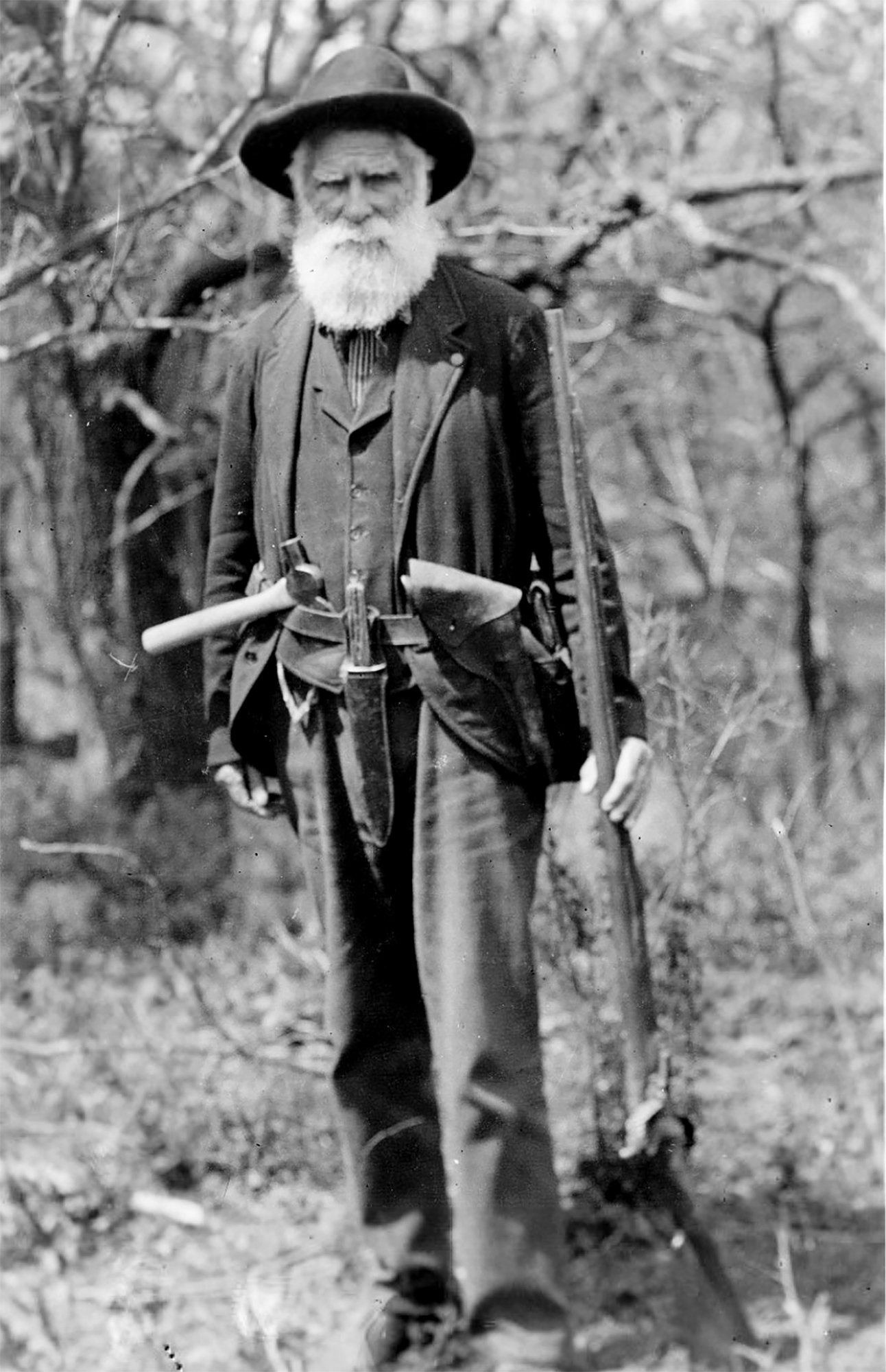
And my gripe is that the U.S. Govt did not provide for these people in any way – just threw out the bait & let them go for it. Did not warn them about the conditions, the hardships, provided no safety net, no place people could go for supplies or warmth in the worst conditions – gave them no knowledge or information opon what they would face or how to face it – nothing. Am I the first one to see this? How the govt was responsible for its citizens that were to open up the West & other uninhabited regions? Is this another phase of Patriarchy – which only sees what it wants, not the plight of the victims? These people, without knowing what they were getting into, faced missing fingers & toes from frostbite – death from disease due to cold & lack of care – little children died. But the Patriarchs no doubt, did not even think of this – just that they wanted outward expansion & fuckk the people – some of them will die, some of them will live, too bad & good luck.
So the pioneers who built cabins as I decribed in places like North Dakota, Minnesota, any place north or in the Rocky Mountains – were in for a surprise. A deadly feature was the traditional fireplace. They thought it was good enough – yes – for mild or average winters. But not for those that hit once in a while – once in a while can kill.
Below is an Asian system stove
The fireplace doe not preserve heat, much goes up the chimney. It needs to be kept stoked 24/7 & that mean constant fire, many trips to the firestack even during whiteout blizzards, as you can’t keep much wood – about 3 days worth – in the cabin that measures 16’x20’.
When it got really cold the walls inside were ice – near the fire, like a few feet, you might be warm. But elsewhere it could be below freezing! How could the entire famiy sleep that way? People got sick shivering all night! And during those unusual winters at the worst conditions – they RAN OUT of firewood! Then what? Burn furniture & floorboards & then? When the fire goes out you die. A few hours – it’s 40 below outside – what do you think?
In some unusual cases there was a man who’d built a cabin properly, with the right kind of construction & heat – the guy you all laughed at. But if somehow you could bundle up & drag yourself & your entire family there, you would be saved.
The ones who survived built like so: A cave with all the supplies, heating, proper ventilation {without ventilation, when your fire eats up all the oxygen you get carbon monoxide – & MANY died from it!} a solid wall & door to the outside – never to be opened until after the bizzard even if it lasts two weeks. You have a tiny vent to the outside to see through. Mind you such a cave was only in the mountains – the Bitterroot Mountains were famous for harsh conditions. Mountain men went there, trappers, not farmers.
There was the man who built two roofs, one atop the other, the outer a steep pitch, with 14” of air in between. His roof was protected from snow cave-ins & his cabin was warmer for the roof insulation.
Another man built two walls around his house & filled the inside with sawdust; conserved much heat.
Another person dug deep into the ground – where the ground, below 4’ – stays a steady temperature of 40 to 50 degrees Fahrenheit. Once you are in that you don’t need as much fire to keep the house warm than if it’s exposed. Think: you start with the house being at zero degrees F – like outside – now warm it up. Or you start the house at 40 F – How much easier it will be! And if you’re completely underground, it stays no less than abut 38 F. Partially under – a dugout – will not be as beneficial but it will help a lot. The Arctic WIND can go through tiny cracks in the wood {& chills the wood itself} but not through the ground!
Other people – including women – built tunnels that led to a large room {with venting of course – I’ve seen the vents around beaver dams!} – Everyone laughed. But when the Arctic conditions came, many saw her chimney smoke & got there to save their lives. She had provisions {food, blankets, etc}, water, warmth, & all needed for survival – she’d planned ahead for emergencies. The others counted on Good Luck {favorable weather} but Luck does not guarantee what you want – preparation, ingenuity, wise planning, being positive & brave, & hard work makes it happen.
In conclusion, of all the features I’ve seen that impressed me, it is the labyrinth stove which stands out. They did NOT incorporate it into the pioneer life except for very rare cases – but if they had, many lives wuld have been saved. Here is its description:
From the Internet: Labyrinth Stone Stoves – used in many European & Asian Countries {Russia, Norway, Ireland, Germany, Scandinavian Countries, Japan, Korea, etc}
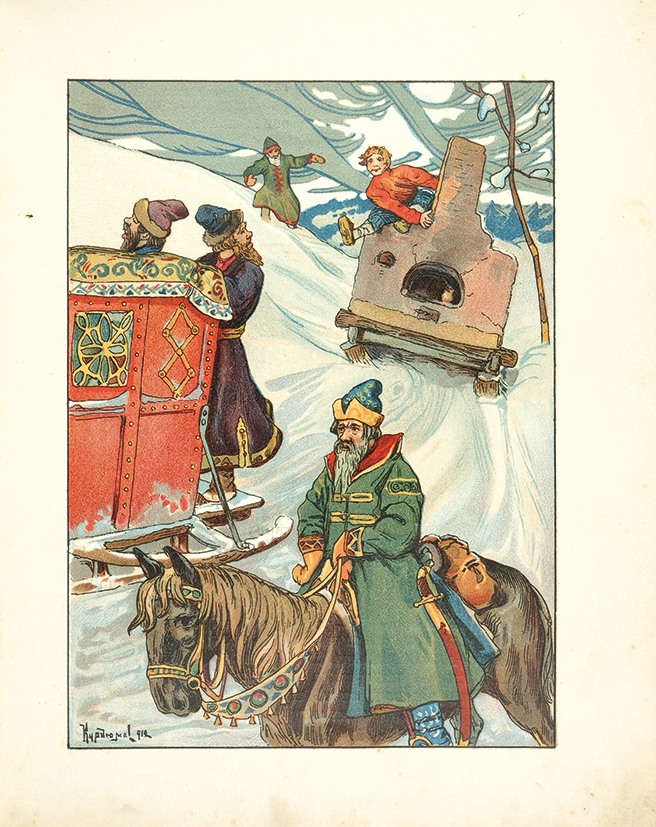
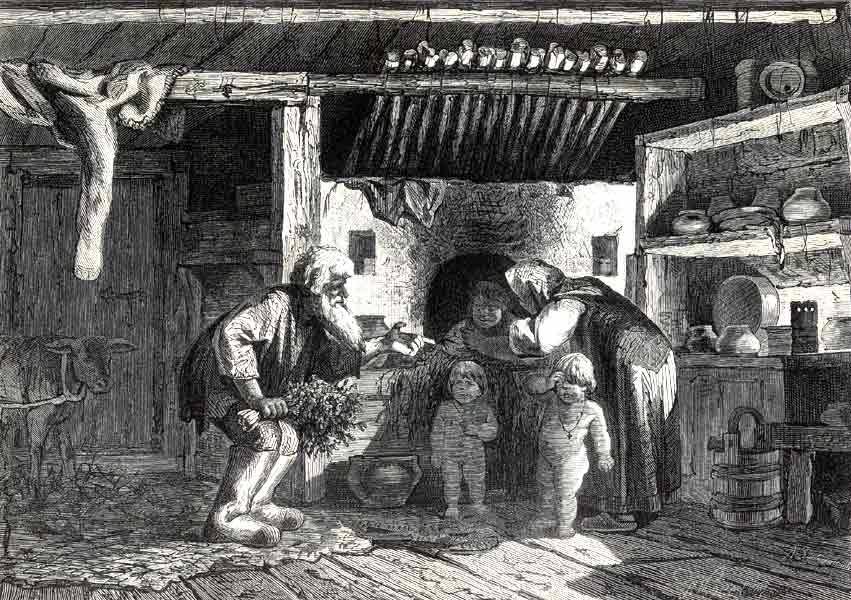
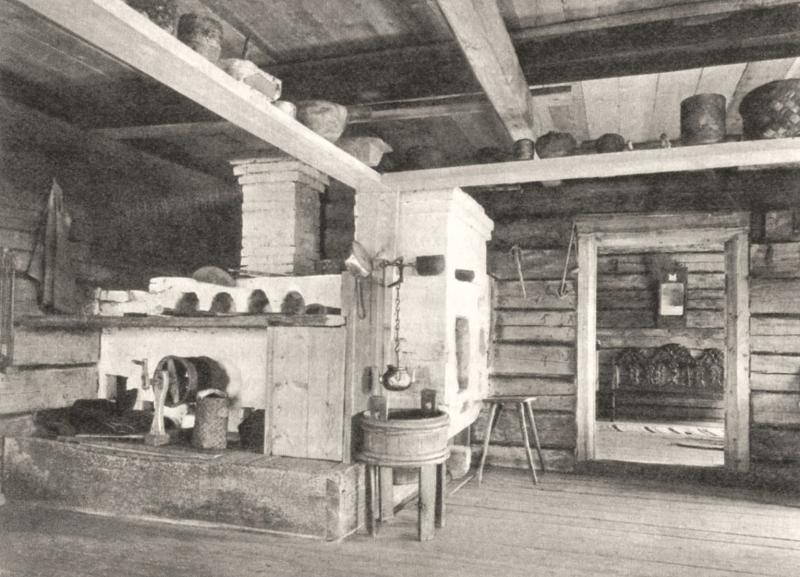
The traditional Russian bread stove, or pech (русская печь), uses a design principle centered on a massive thermal mass and a labyrinthine system of internal flues to efficiently capture, store, and radiate heat.
Design Principles
- Massive Thermal Mass: The pech is an enormous structure, often weighing 1-2 tons, built from firebrick and clay. This substantial mass is slow to heat up but, once saturated, acts as a heat battery, slowly and evenly releasing warmth into the home for up to 12-24 hours, long after the fire has gone out. This radiant heat creates a comfortable living environment and is efficient for heating the whole house, a traditional izba log hut.
- Labyrinth of Piping (Flues): Hot smoke and combustion gases do not travel directly up a chimney. Instead, they are channeled through a complex maze-like network of internal passages or flues (called kolenya, or “knees”) within the brick structure.
- Heat Exchange: The extended path of the hot gases through the “piping” forces the heat to transfer to the surrounding masonry. By the time the exhaust reaches the chimney flue, its temperature is significantly reduced, maximizing the heat transfer to the stove’s body and thus the home. This design makes the outer surface warm to the touch, but not dangerously hot, and allows for functions like sleeping platforms built into the stove structure.
Functions
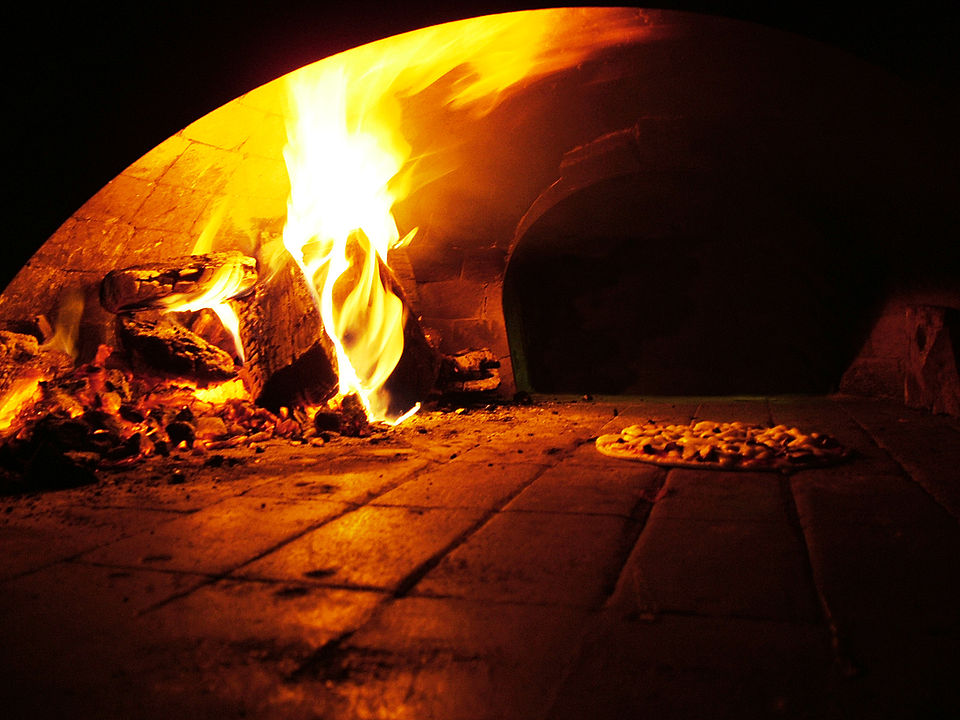
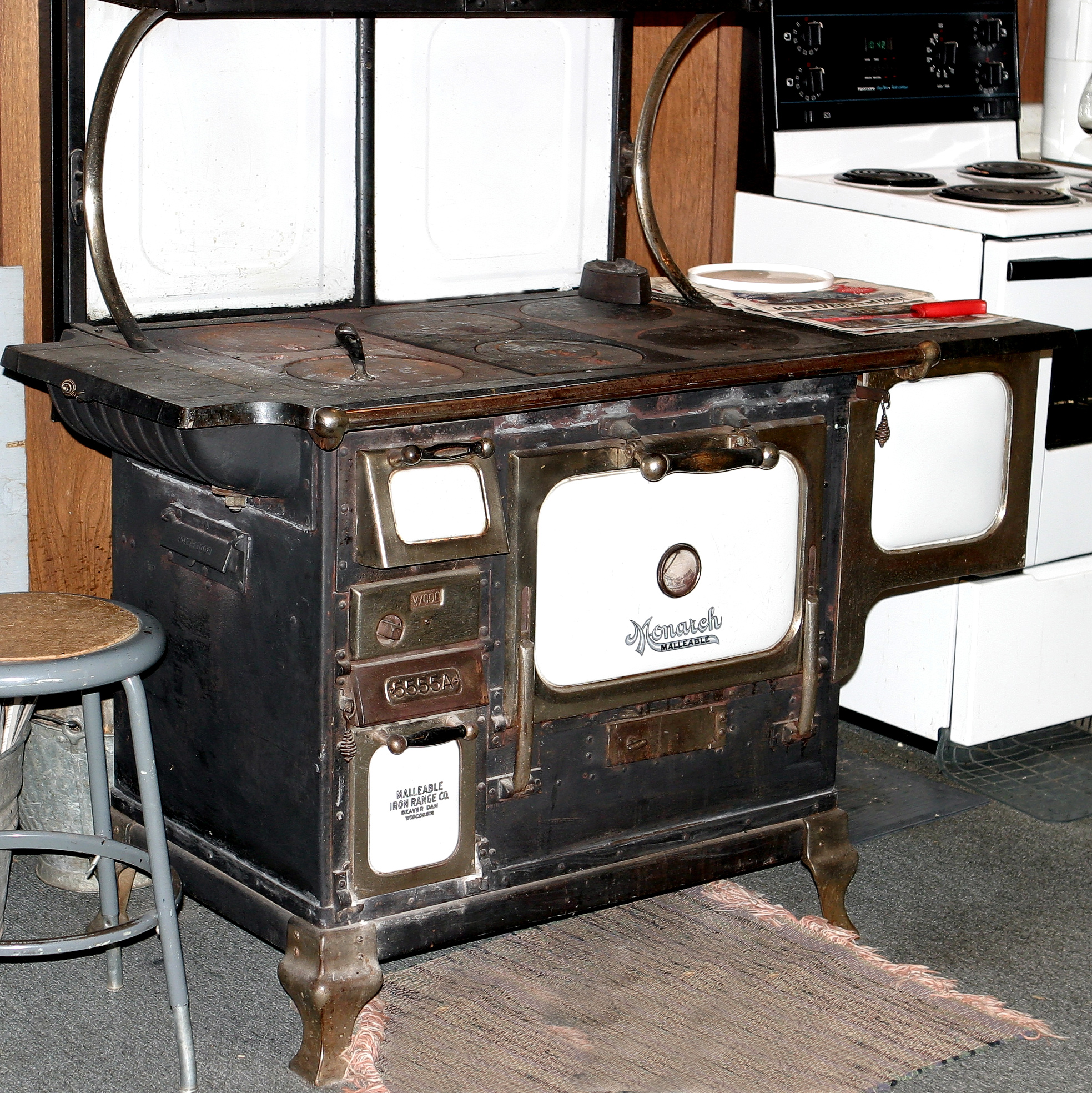
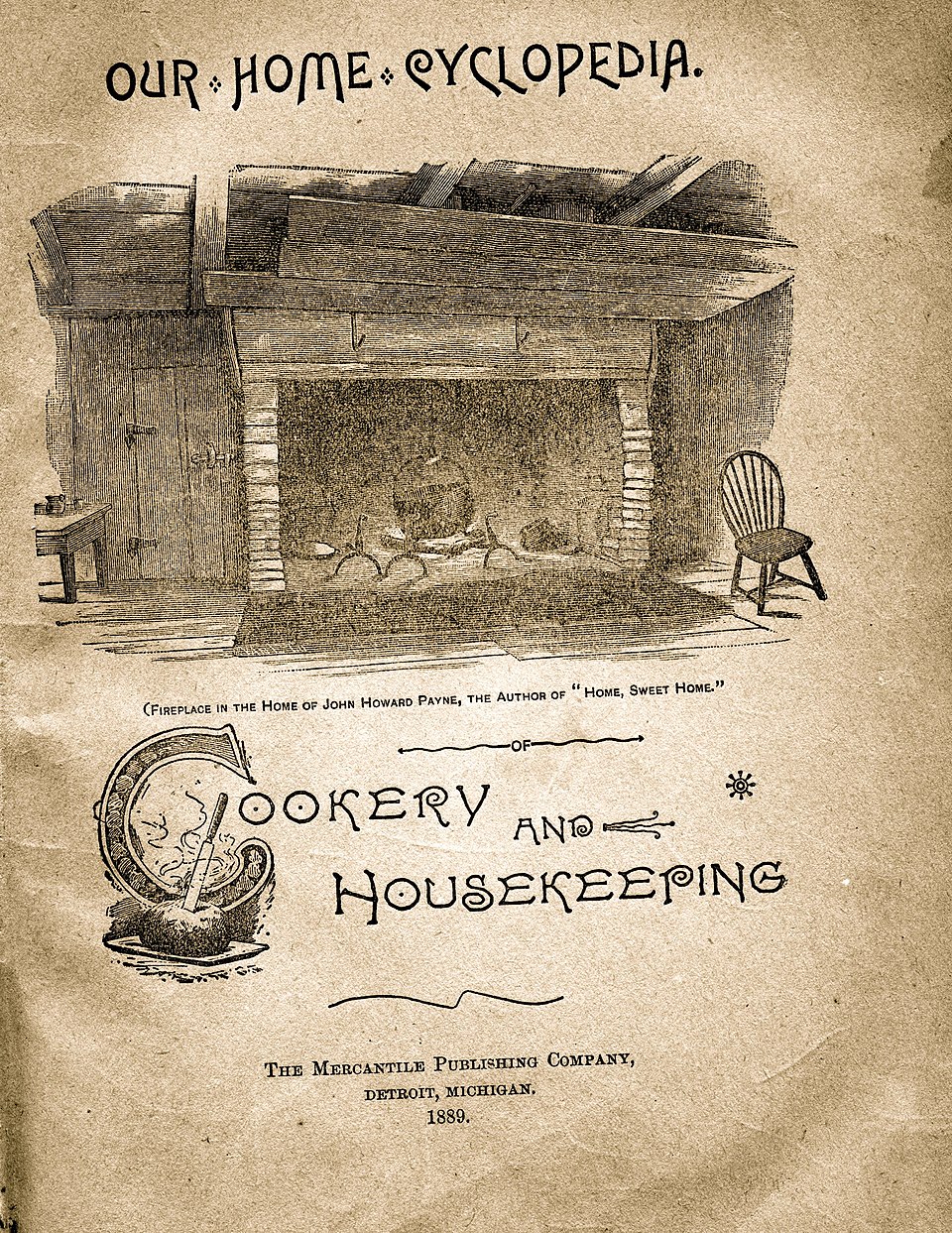
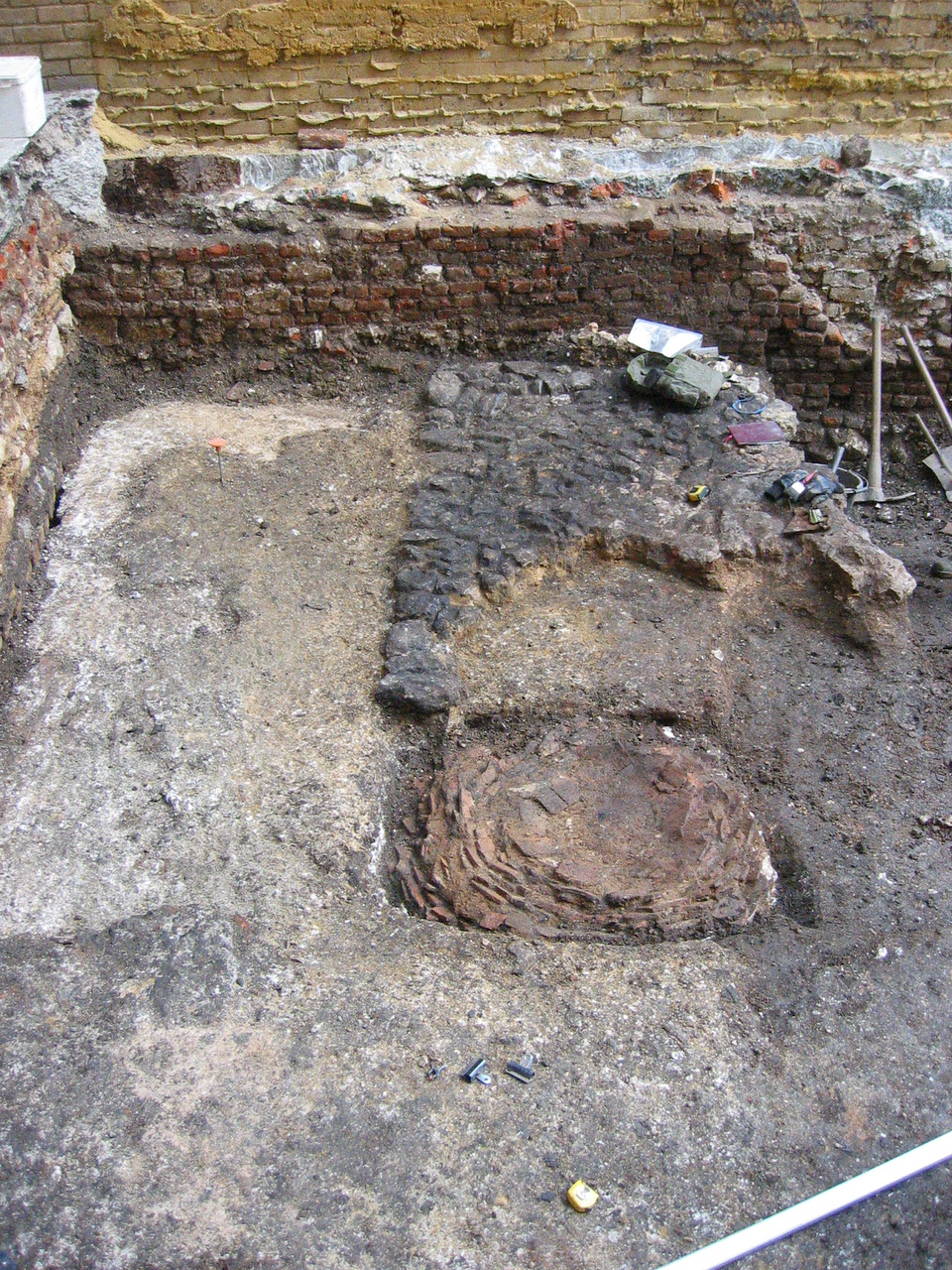
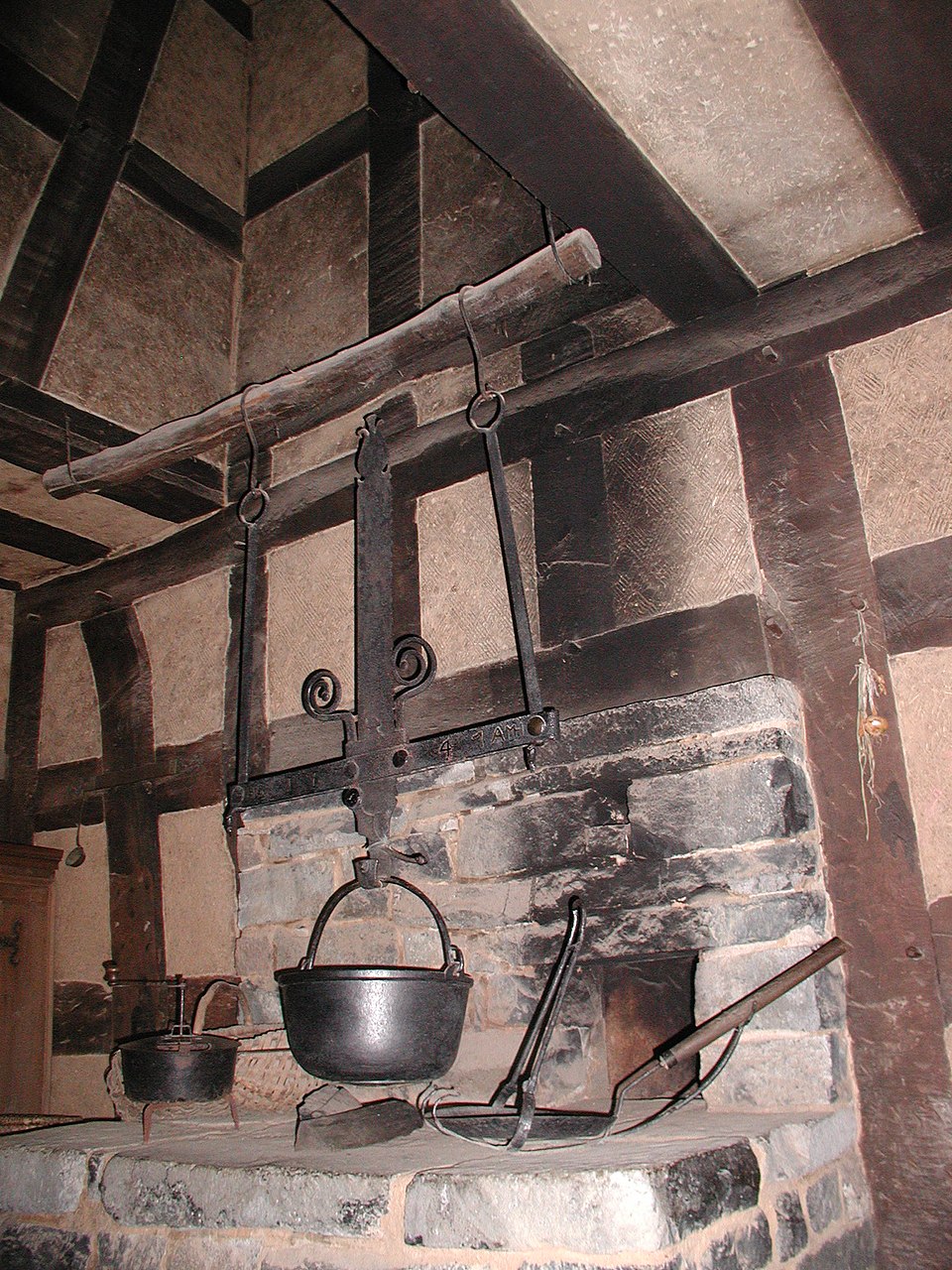
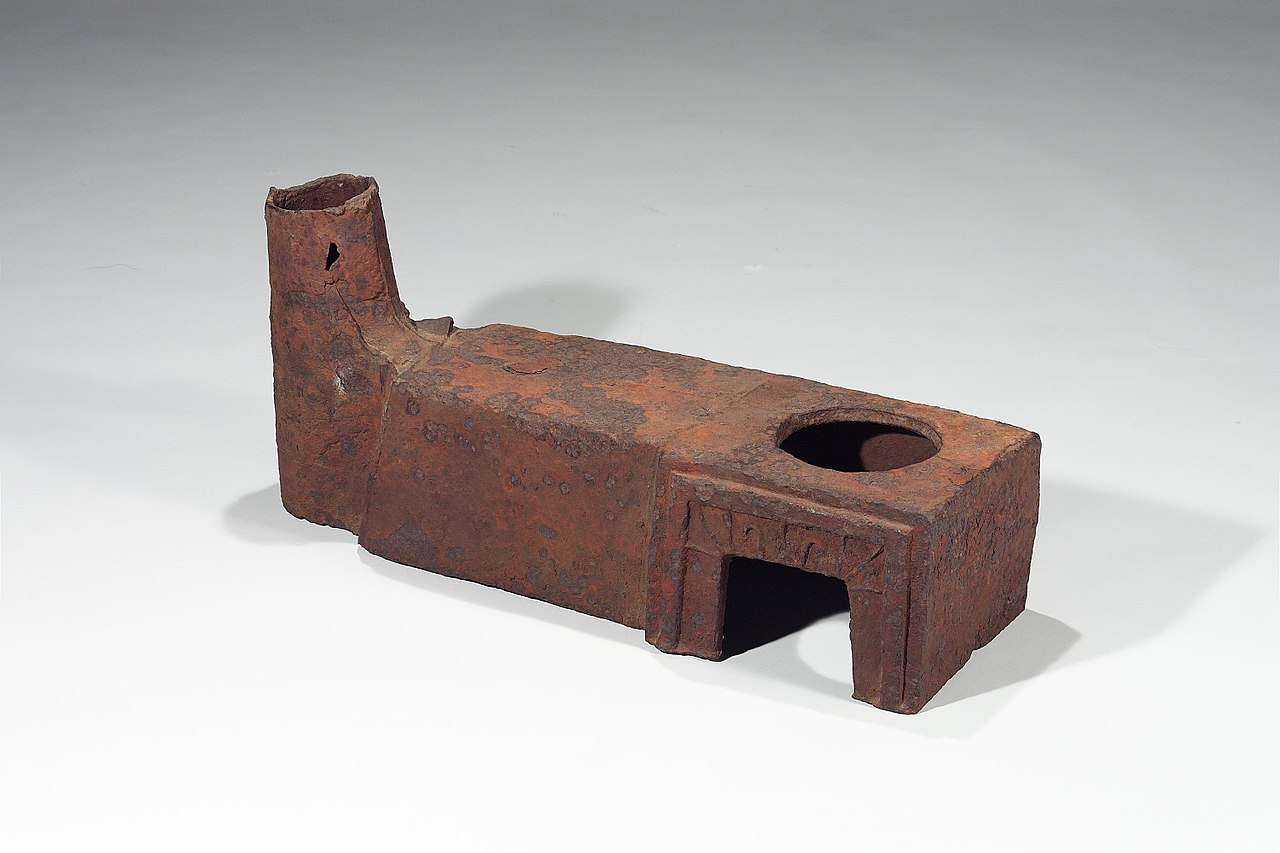
Below some examples of heating & cooking appliances used in the early days – the pioneers could NOT carry any iron stoves in their covered wagons – too heavy – they were lucky to carry what they had, nothing extra. They could not even afford HORSES – usually CATTLE pulled their wagons! Most of these poor settlers used the fireplace for their cooking.
Beyond heating, the pech serves multiple purposes in a traditional Russian household:
- Cooking and Baking: The large main hearth bakes bread with a unique, even heat and is used to cook food for long periods at a steady, decreasing temperature (a process called tomlenie, or “languor”), which imparts a distinctive taste to dishes.
- Drying: The warmth is used for drying clothes, herbs, and mushrooms.
- Bathing/Sleeping: The flat top of the stove often features a raised platform where people would sleep during cold winters. The main chamber could even be cleaned out and used for bathing with heated water.